
Writers spend a lot of time waiting for emails.
Agents might want your manuscript. Publishers might love your book. We really hope there are exciting opportunity waiting for all of you.
But when an email arrives saying exactly what you’ve been hoping to hear, it is very easy for excitement to take over.
Unfortunately, scammers know this.
Why writers can be particularly vulnerable
Publishing involves rejection, waiting and uncertainty. You may have spent years working on a book and months sending it out into the world.
That makes an unexpected email saying “We love your work” incredibly powerful.
Scammers can exploit that emotional vulnerability. They may pretend to be publishers, literary agents, editors, book marketers, competition organisers or even genuine companies whose names they have copied. It happens to us a lot and we had a great one only last week!
The message might offer publication, representation, promotion, an award, a review or some mysterious opportunity that apparently requires you to act quickly.
Not every unsolicited email is fraudulent, of course. But an exciting email deserves the same scrutiny as a suspicious one.
Check the actual email address
This is one of the simplest checks you can make.
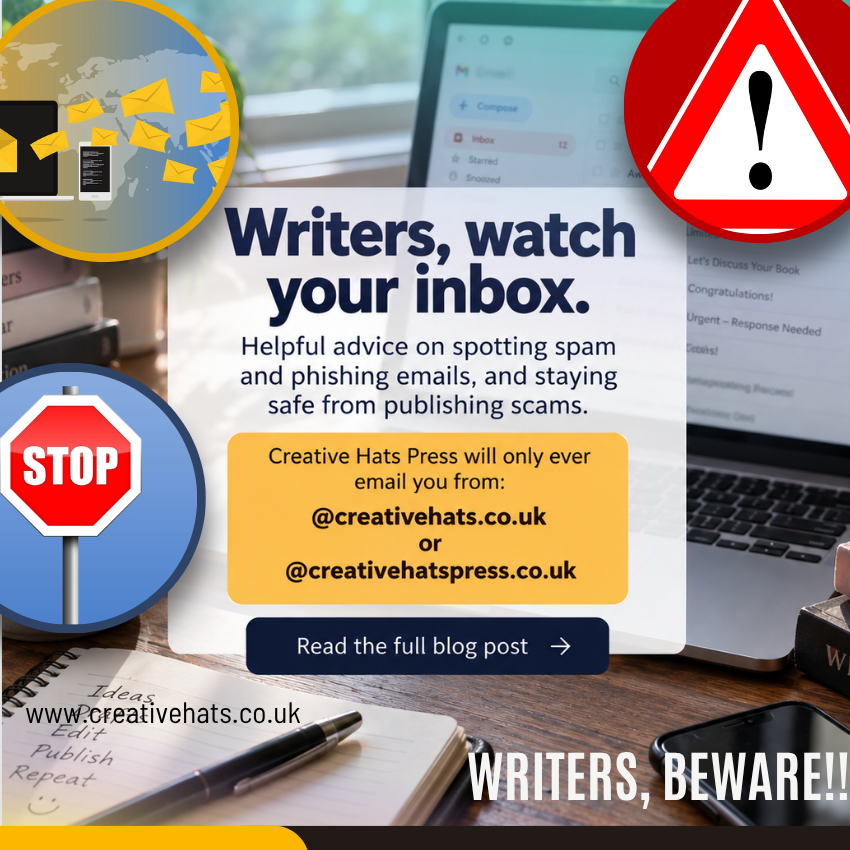
Creative Hats Press will only contact you officially from email addresses ending in:
@creativehats.co.uk
or
@creativehatspress.co.uk
Someone can write “Creative Hats Press” in the sender-name box. That does not mean the email came from us.
Open or expand the sender details and look at the complete email address.
An address such as:
creativehatspress@gmail.com
creativehatspress@outlook.com
submissions.creativehats@yahoo.com
creativehatspress@publishing-opportunities.com
is not an official Creative Hats Press email address, regardless of how convincing the rest of the message looks.
If you receive something claiming to be from us and you are unsure, don’t reply to the suspicious email. Contact Creative Hats Press separately using the contact details on our official website. Please forward anything suspicious to us if you feel safe and confident to do so but we stress do not reply, open or press any links.
Warning signs to look for
Be particularly cautious when an email:
- creates urgency or tells you that you must respond or pay immediately;
- asks unexpectedly for money, bank information, passwords or login details;
- contains a link asking you to sign into an account;
- includes an attachment you weren’t expecting;
- promises guaranteed sales, bestseller status, representation or publishing success;
- claims somebody important has personally selected or discovered your book but gives very little specific information about it;
- asks you to move quickly onto WhatsApp, Telegram or another messaging service;
- offers an impressive opportunity but requires an upfront payment before explaining it properly;
- uses a company or person’s real name but sends from an unrelated email domain.
One warning sign doesn’t automatically mean something is fraudulent. Several together should make the alarm bells considerably louder.
Don’t let urgency make the decision for you
A legitimate publishing opportunity should survive ten minutes of investigation.
Before clicking, paying or supplying information, stop and check.
Search independently for the company. Visit its website by typing the address yourself rather than following the email link. Check whether the person contacting you actually works there. Look at the email domain carefully.
If someone claims to represent an established publisher or agency, you can contact that organisation separately and ask whether the approach is genuine.
And never be embarrassed about checking.
Be careful with links and attachments
A phishing email may contain a button that appears to take you to Google, Microsoft, Amazon, a publisher or another familiar service.
The page you reach may look almost identical to the genuine login page.
Its purpose can be to collect your email address and password.
Instead of following an unexpected link, open your browser and visit the organisation’s website independently.
The same principle applies to attachments. If you weren’t expecting a document, invoice, contract or manuscript file, verify the sender before opening it.
Protect the accounts connected to your writing
Your email account can be the gateway to manuscripts, publishing platforms, social media, cloud storage and financial information.
Use strong, unique passwords and enable two-factor authentication wherever it is available.
Don’t reuse the same password across your email, Amazon/KDP, website, social media and other publishing accounts. If one service is compromised, reused passwords can turn one stolen login into a trail of falling dominoes.
A special warning about praise
This is perhaps the hardest one.
Scammers don’t always frighten people into acting.
Sometimes they flatter them.
They may tell you your book has extraordinary commercial potential. They may claim that a producer is interested in adapting it, that an international publisher wants the rights or that they can dramatically increase your sales.
Before paying anyone, ask:
Who are they?
Why have they contacted me?
Can I verify them independently?
What exactly am I being asked to pay for?
And even then if the company is legit and the opportunity decent but costly – carry out a quick google search and ask how reputable the company is. Find out who has been published by them previously and contact them to ask after their experience. We get quite a few writers who started their journey elsewhere and paid good money for a very sub-standard service.
We might be relatively early in the publishing business and not as quick as writers hope but we do not take money upfront or charge for services. If and when your book earns money – you earn money and we take a percentage. Publishing 101.
What happens if I say no today and investigate tomorrow?
A genuine opportunity should withstand questions.
If you think you’ve received a scam email
Don’t click further links or download attachments.
Don’t reply with additional personal information.
Take screenshots or keep a copy of the email if you may need to report it. Change passwords promptly if you have entered login information into a suspicious website, and contact your bank or relevant service immediately if financial information has been compromised.
In the UK, suspicious emails can also be forwarded to the National Cyber Security Centre’s Suspicious Email Reporting Service at report@phishing.gov.uk.
If an email claims to be from Creative Hats Press
Please remember this simple rule:
Official Creative Hats Press emails will only come from an address ending @creativehats.co.uk or @creativehatspress.co.uk.
If something doesn’t look right, don’t worry about offending us by checking.
We would much rather receive a message asking, “Did you actually send this?” than discover that somebody trusted an email simply because our name was attached to it.
Writers already have enough fictional villains to deal with.
If you got this far – thanks for reading and if somehow you are yet to subscribe, press the button, go on, do it now before you forget. We also have a social post on this today so be sure to follow our socials for the most up to date news.
Leave a Reply