
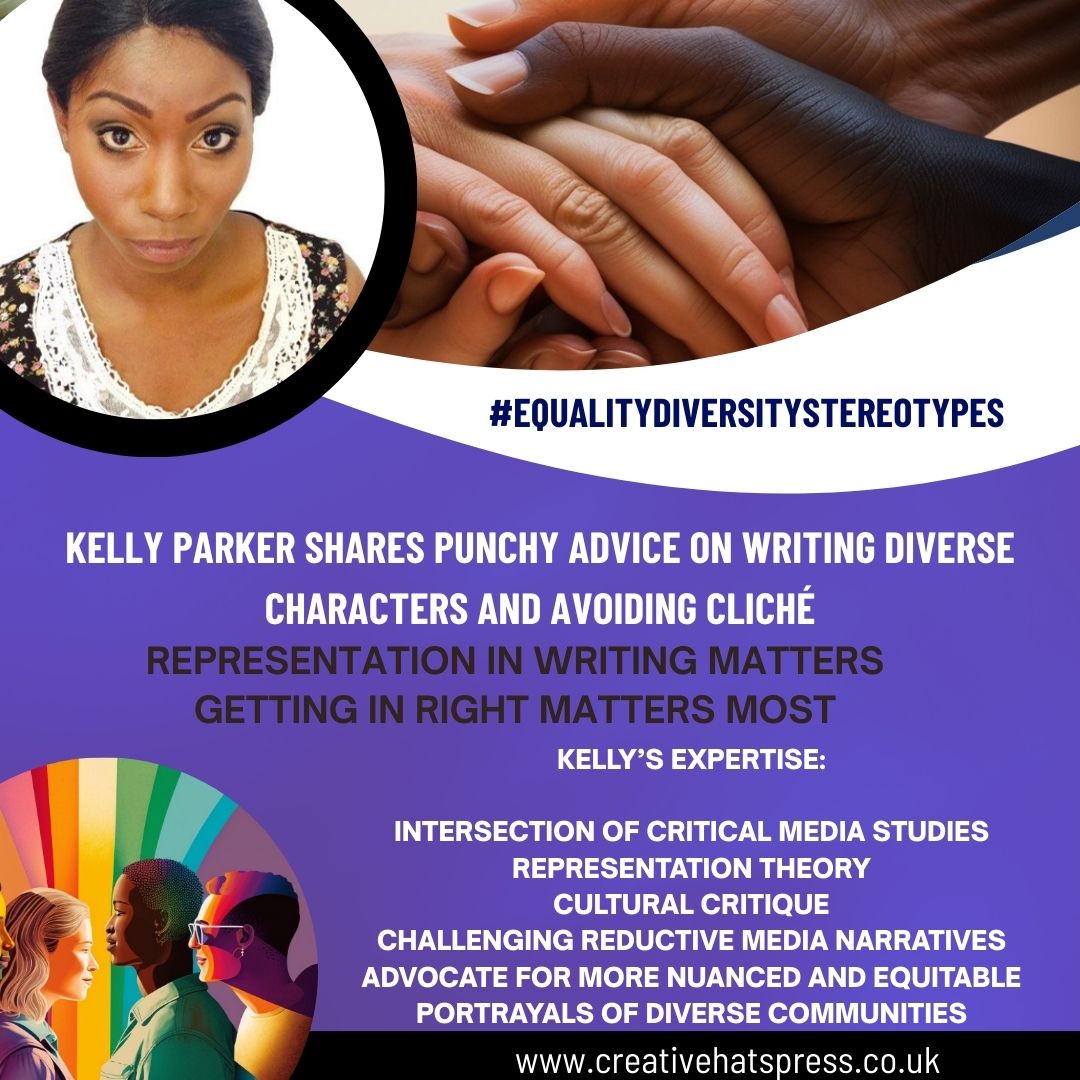
By Kelly Parker
Creative Hats Press
Writing Diversity Without the Clichés
By Kelly Parker
One of the questions I’m asked most often is how writers can include diversity in their work without it feeling forced, tokenistic, or painfully predictable. The short answer is this: stop thinking of diversity as an addition and start thinking of it as a reflection of the world you already live in.
Clichés creep in when characters exist to make a point rather than to live a life. If a character’s race, culture, or background is doing all the narrative work, readers will feel it immediately. Instead, begin where you would with any strong character: desire, contradiction, fear, humour, habit. People are never just representatives of an identity; they are shaped by it, complicated by it, and often resistant to the boxes others place them in.
Research matters, but so does humility. Reading widely, listening carefully, and engaging with voices beyond your own experience helps avoid recycled stereotypes. At the same time, remember that no community is monolithic. If you’ve “seen this character before,” chances are you’re leaning on familiarity rather than truth. Ask yourself on whose perspective you’re focused and why.
Another useful test is to look at function. Would this character still exist if their identity were removed? If the answer is no, that’s not automatically a problem, but it does mean you should examine whether they’ve been reduced to a symbol. Diversity is most powerful when characters are allowed narrative agency: they make decisions, they get things wrong, they change.
Language is where many writers stumble. Overexplaining culture, translating emotions for the reader, or announcing difference too loudly can flatten nuance. Trust your audience. Specificity, when handled with care, is far more engaging than generalisation. Let detail emerge naturally through action and dialogue rather than exposition.
Finally, be prepared to be uncomfortable. Writing beyond your own experience should feel risky. That discomfort isn’t a sign you shouldn’t try; it’s a sign you’re paying attention. The goal isn’t perfection, but honesty, curiosity, and a willingness to revise.
Diverse writing doesn’t need to shout. When it’s done well, it simply feels real.
About the author
Kelly Parker is a doctoral researcher and research teaching associate at Falmouth University’s School of Communication, where her work critically explores the representation of Black, Indigenous, and people of colour (BIPOC) in media and advertising. Her doctoral research focuses on the prevalence and impact of stereotypical portrayals of BIPOC communities, particularly how these representations are embedded within contemporary advertising practices and influence societal perceptions and lived experiences.
In addition to her PhD work, Kelly contributes to academia as a visiting lecturer, teaching on topics including media representation and stereotyping, and supports students as an online tutor in post-digital content. She also engages with feminist and cultural scholarship as a contributing editor to MAI: Feminism and Visual Culture, and her published research spans gender and feminism, Black history and cultural studies, and analyses of public messaging during the COVID-19 pandemic and its effects on BIPOC communities in the UK.
Kelly’s expertise lies at the intersection of critical media studies, representation theory, and cultural critique, and her work actively challenges reductive media narratives while advocating for more nuanced and equitable portrayals of diverse communities.
Leave a Reply