
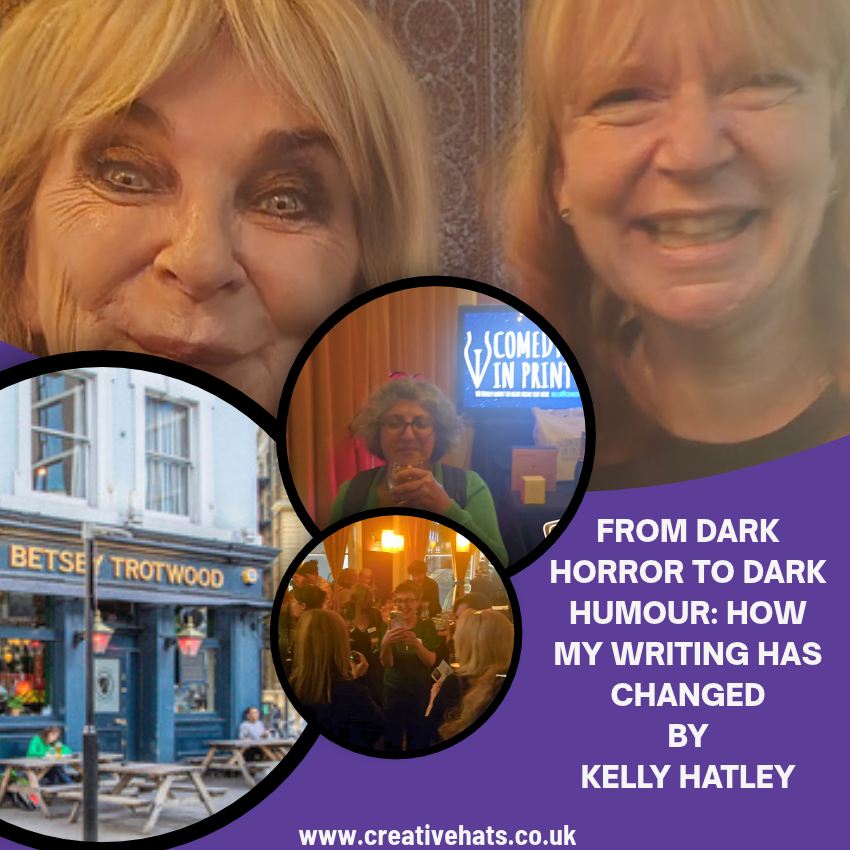
By Kelly Hatley
If you follow our socials you’ll see that in October, I attended a beautiful fundraising evening for Comedy Women in Print, following an invitation from Helen Lederer. If you don’t follow our socials – jump on to see what we get up to behind the scenes. There were conversations about books and publishing, inspiring stories from women writers, and plenty of laughter.
The evening made me reflect on how I ended up there. My intro to comedy began with, I’m not funny. Dark, weird, unsettling, yep that’s me. I love watching comedy and supporting comedians but the thought of getting involved in creating comedy had me more scared than watching a Terrifier movie.
My early writing was inspired by the surreal, the macabre and the things we would generally prefer not to think about. Stories that questioned what people were capable of, unsettled familiar situations. My work often required a trigger warning.
Tales of the Rejected gives a good indication of where my imagination liked to wander. Its stories explore rejection and wrongdoing, with disturbing material and ordinary situations taking unpleasant turns. Even the title suggests that something has gone wrong.
Then there is Causeway, my dark, surreal and uncanny tale set on Lindisfarne Island. Even when I chose somewhere beautiful, I still felt the need to make everyone uncomfortable.
Looking back, perhaps some humour needed to get out. I just hadn’t worked out what how to do that.
During my MA in Creative Writing at the University of Hertfordshire, my teacher, Dr Jennifer Young, mentioned that she had been asked to be a guest judge for CWIP – Comedy Women in Print.
That conversation sent me exploring comedy writing, although I felt so unqualified to attempt it, I even applied for a PhD to work out how.
Writing horror was one thing. Trying to make somebody laugh felt much more exposing. If you frighten someone, they might go quiet. If you fail to make them laugh, they also go quiet. Not good.
But I thought maybe I could combine comedy with something I already loved. Horror.
After all, I loved Shaun of the Dead. I knew fear and laughter could work together. I enjoyed watching characters deal with something appalling while remaining distracted by the petty, awkwardness of being human.
Back in 2018, I could find plenty of books about how to write comedy and plenty about how to write horror. Finding practical guidance specifically about writing horror-comedy was another matter. There seemed to be very little available to help me understand how to bring the two together on the page.
How much could you make readers laugh while simultaneously making them uncomfortable? Would I get cancelled before I got started? What happened when a character’s response to a terrifying situation was completely inappropriate?
I wanted to find out.
When Jennifer moved to Falmouth University, we began discussing the possibility of my starting a PhD with her as my supervisor. That opened up a much deeper exploration of horror-comedy: reading it, writing it, questioning it and trying to understand how it worked.
My love of the genre grew from there.
The PhD itself was eventually placed on hold. I had spent five years studying part-time, during and after Covid, while juggling family life and work commitments. Something had to give.
I was sad to pause it. There was a great deal of time, thought and hope tied up in that research. But alongside it, my work was growing, and I chose to follow that opportunity.
What I had been learning began finding its way into classrooms.
Through Creative Hats Press and the education charity The Brilliant Club, I started teaching horror-comedy courses I had designed myself. That has been life-changing.
There is something wonderful about giving young people permission to explore the frightening and the ridiculous together. They can question expectations, experiment with tone and discover what happens when a reader is pulled between two different reactions.
Each week, I bring those skills, questions and discoveries into my work in schools, local colleges, communities and universities. The research continues to shape what I teach, while the teaching gives me fresh reasons to think about the writing.
And there is plenty more coming.
My own series of young adult horror-comedy books is due to begin appearing at the end of this year. This summer, I secured funding to help me drive to Transylvania and back to research the first book in the collection – you may have watched the shenanigans on our socials. If you didn’t then go now and connect. I’ll wait.
Next month, my first nonfiction book about writing horror-comedy, Knock, Knock, Who’s Fear?, will also be published.
The book accompanies my courses and draws on my work with young people. It connects creative writing with skills relevant to GCSE English Language and Literature at Key Stage 4, and A-level study at Key Stage 5: thinking critically, exploring language and structure, considering readers’ responses and making deliberate choices about how a story works.
It is a book I would have liked to find when I first started asking how to write this combination of fear and laughter.
So, being at the CWIP evening, meeting writers and hearing about their successes, I felt thankful. Thankful to Helen Lederer for setting it up and to the women sharing their work and experiences, and to Jennifer for a conversation that helped change the direction of my work.
I went from being drawn towards horror to discovering how much I loved exploring the humour within it. That shift has influenced my research, my books, my teaching and the opportunities I can now offer other writers.
I still understand the person who says, “I couldn’t write comedy. I’m not funny.”
I said it myself.
But women and girls can be funny before they recognise it in their own writing. Sometimes they just need encouragement, room to experiment and the chance to discover that their way of seeing the world can make somebody else laugh.
Jennifer helped me see that.
Now I am finally getting to pass it on.
Leave a Reply